Top Hydraulic Pile Drivers for Mid-Size Excavators: SV-200 and SV-400 Review
For buyers working with mid-size carriers, the pile driver shortlist usually comes down to one practical question: which hydraulic pile driver actually matches the excavator already on site? In the 20–40 t band, VIBRA's published model data points to two units — the SV-200 for 20–25 t carriers and the SV-400 for 32–40 t carriers. The SV-200 is listed with a 459 kN centrifugal force and a 2,280 kg body weight. The SV-400 is listed with 656 kN and 3,870 kg. Both are side-grip units with 360° rotation and ±30° tilt, and the SV-400 adds higher clamp forces — 520 kN at the bottom clamp and 465 kN at the side clamp — for heavier piling work.
This review compares the two models specification by specification, sets out the six checks that decide whether a unit fits a given carrier and job, and positions both against published market benchmarks for the same excavator classes. It is written for the evaluation stage: you already know a vibratory attachment is the right tool, and you need to confirm which model, at what configuration, with which documentation.

SV-200 and SV-400 at a glance
- VIBRA SV-200 — 20–25 t excavator class; 459 kN centrifugal force; 2,300–3,000 rpm frequency; 335 kN side clamp and 385 kN bottom clamp; 2,280 kg; 360° rotation with ±30° tilt.
- VIBRA SV-400 — 32–40 t excavator class; 656 kN centrifugal force; 2,300–3,000 rpm frequency; 465 kN side clamp and 520 kN bottom clamp; 3,870 kg; 360° rotation with ±30° tilt.
- Shared platform data — both models run at a 32 MPa operating pressure and are built on a high-strength steel body.
- Hydraulic demand — 170–230 L/min for the SV-200 and 230–280 L/min for the SV-400.
- Manufacturer — Shanghai Yekun Construction Machinery Co., Ltd., trading under the VIBRA brand.
Why matching a pile driver to a mid-size excavator is harder than it looks
The most common failure in this equipment class is not a defective hammer. It is a mismatched pairing between a carrier, an attachment and a pile section, and the mismatch is usually invisible until the machine is already on site.
Carrier and attachment mismatch. The SV-400 carries a 3,870 kg working mass and is specified for 32–40 t carriers; the SV-200 is 2,280 kg and specified for 20–25 t carriers. Mounting the heavier unit on a smaller machine changes the carrier's stability envelope and its hydraulic duty. Running the lighter unit on a larger carrier places the attachment below the class it was designed for. The published applicable excavator class is therefore the first specification to read, not the last.
Hydraulic capacity mismatch. Both SV models list a 32 MPa operating pressure, but their flow demand differs: 170–230 L/min for the SV-200 against 230–280 L/min for the SV-400. A carrier must be able to supply the listed pressure and flow; where it cannot, the attachment is not operating at its rated condition. For buyers, this is a base-machine question that should be answered before commercial terms are discussed.
Specification comparability. Catalogs in this category are not written to one standard. Some list rotational speed in rpm and others in vpm; some publish a rated excitation force and others a maximum; clamp force may be quoted at the side clamp or at the bottom clamp. A category-level data review flagged that marketed “high speed” claims above 3,000 rpm and standard industrial frequency ranges, commonly around 2,000–2,800 rpm, diverge enough that physical verification is required. Any comparison that ignores the definition behind a number is unreliable.
Pile and ground demand. Pile type and ground conditions set the minimum force floor. Heavier sections and denser ground generally call for more centrifugal force and more clamp force to keep the section gripped and moving. VIBRA's product data describes the range as capable of driving cement sheet, steel plate, steel tube, H-steel and wooden piles, so the pile you drive is as much a selection input as the excavator class you own.
Mid-size carriers in the pile driving equipment market
Pile foundations are one of the most widely used deep foundation solutions, according to a peer-reviewed study on intelligent information modelling for pile foundation design published in MDPI's Buildings. Demand for pile driving equipment follows directly from that position in foundation engineering.
Within that demand, the equipment taxonomy matters. A descriptive industry overview lists the most commonly used machines as diesel hammers, vertical travel lead systems, hydraulic hammers and hydraulic press-in machines. Excavator-mounted vibratory drivers such as the SV-200 and SV-400 sit in the hydraulic hammer family, and buyers choose them mainly because they are carrier-mounted rather than crane-suspended.
On market scale, a commercial research firm projects the global pile driving equipment market expanding from an estimated USD 1.9 billion in 2024 to about USD 2.7 billion by 2030. That figure covers pile driving equipment broadly rather than hydraulic pile drivers alone, and the full methodology was not disclosed in the available source, so it is directional context for budget cycles rather than a segment-level forecast.
Application demand reported by the supplier covers watercourse embankments, house foundations, municipal networks and bridges. In the United States, dedicated pile drivers also fall under OSHA 1926.1439, which sets operational requirements for dedicated pile drivers and includes a provision that applies only to dedicated pile drivers manufactured after 8 November 2011. For importers supplying US projects, that is a hard requirement rather than a formality.
The shortlist: how the SV-200 and SV-400 compare
VIBRA SV-200 — the 20–25 t class option
The SV-200 is listed with a 459 kN centrifugal force and a 2,300–3,000 rpm vibration frequency, on an eccentric moment of 4.6 as stated in the model data block. Clamp force is 335 kN at the side clamp and 385 kN at the bottom clamp, with a 32 MPa operating pressure and a 170–230 L/min flow requirement. The body measures 1,144 mm long, 1,182 mm wide and 2,166 mm high, at 2,280 kg total weight, and the unit rotates 360° with ±30° tilt.
For a 20–25 t carrier, the 2,280 kg mass keeps mounting demand within the class, which matters where the same machine has to be moved between sites. The clamp figures are the numbers to check against the pile section first: they set what the attachment can grip, and therefore how much of the vibratory energy reaches the pile rather than the clamp body.
VIBRA SV-400 — the 32–40 t class option
The SV-400 is listed with a 656 kN centrifugal force, a 6.6 kg·m eccentric moment and the same 2,300–3,000 rpm frequency band. Clamp force rises to 465 kN side and 520 kN bottom; operating pressure remains 32 MPa, while flow demand increases to 230–280 L/min. The body measures 1,399 mm by 1,401 mm by 2,783 mm at 3,870 kg, with the same 360° rotation and ±30° tilt.
The step up from the SV-200 is 197 kN of centrifugal force, 130 kN of side clamp force and 135 kN of bottom clamp force, carried on a machine 1,590 kg heavier. That increment is what the 32–40 t class buys: more force delivered into heavier sections, and a clamp that holds them under sustained driving.
SV-200 versus SV-400: specification comparison
| Parameter | SV-200 | SV-400 |
|---|---|---|
| Applicable excavator class | 20–25 t | 32–40 t |
| Centrifugal force | 459 kN | 656 kN |
| Vibration frequency | 2,300–3,000 rpm | 2,300–3,000 rpm |
| Eccentric moment | 4.6 (unit not stated in the SV-200 data block) | 6.6 kg·m |
| Side clamp force | 335 kN | 465 kN |
| Bottom clamp force | 385 kN | 520 kN |
| Operation pressure | 32 MPa | 32 MPa |
| Operation flow | 170–230 L/min | 230–280 L/min |
| Rotation / tilt angle | 360° / ±30° | 360° / ±30° |
| Dimensions (L × W × H) | 1,144 × 1,182 × 2,166 mm | 1,399 × 1,401 × 2,783 mm |
| Weight | 2,280 kg | 3,870 kg |
| Material | High-strength steel | High-strength steel |
Reading note: the SV-200 data block lists the eccentric moment as 4.6 without a stated unit, while the SV-400 block states 6.6 kg·m. Confirm both values against a current manufacturer datasheet before using them in a tender document.
Market benchmarks for the same excavator classes
Two published comparator listings help buyers place these figures in context. A listing by Yantai Juxiang Construction Machinery for its S500 excavator-mounted sheet pile hammer, for 30 t machines, states a 2,800 rpm vibration frequency and a 450 kN rated excitation force. Because the two sources may define excitation force differently and neither publishes test conditions, this is a positioning reference rather than a performance verdict.
A separate vibratory driver brochure for the J&M Model 26+335 states a maximum frequency of 2,000 vpm, 115 kN centrifugal force and 270 kN maximum crowd or extraction force, for driving and extracting sheet piles, trench plates, wood planks and guardrail posts. The vpm versus rpm terminology and the different force definitions mean this should be read as a market-spread reference only, not as a like-for-like comparison with either SV model.
| Model (source) | Class | Frequency | Force | Source note |
|---|---|---|---|---|
| VIBRA SV-200 | 20–25 t excavator | 2,300–3,000 rpm | 459 kN centrifugal force | Manufacturer model data |
| VIBRA SV-400 | 32–40 t excavator | 2,300–3,000 rpm | 656 kN centrifugal force | Manufacturer model data |
| S500, Yantai Juxiang Construction Machinery | 30 t excavator | 2,800 rpm | 450 kN rated excitation force | Commercial listing; definitions may differ |
| J&M Model 26+335 | Not stated | 2,000 vpm maximum | 115 kN centrifugal force; 270 kN max crowd / extraction | Comparator brochure; vpm and force definitions differ |
A note on “3,200 rpm” and “435 kN” catalog claims
Buyers researching this class will encounter listings and search results that reference a 3,200 rpm hydraulic pile driver or a 435 kN hydraulic pile driver. In the model data reviewed for this article, the SV-200 and SV-400 are listed at 2,300–3,000 rpm with 459 kN and 656 kN centrifugal force respectively, and the other VIBRA listings reviewed state 2,500 rpm and 2,800 rpm figures. The category-level data review identified marketed “high speed” claims above 3,000 rpm as an unresolved verification gap against standard industrial frequencies around 2,000–2,800 rpm.
The practical implication is simple. For any 3,200 rpm or 435 kN claim, ask for the manufacturer datasheet and the test conditions behind the number — rated versus maximum, rpm versus vpm, and the definition of force being quoted — before that figure enters a technical shortlist or a tender comparison. On the flow side, the base machine has to supply 32 MPa at 170–230 L/min or 230–280 L/min depending on the model, and supply at the carrier end is what ultimately determines whether the rated figures can be used.
How to evaluate an SV-200 or SV-400 against your job: a six-step process
Step 1 — Confirm the carrier class
Match the excavator you own against the published ranges: 20–25 t for the SV-200 and 32–40 t for the SV-400. If your fleet sits between 25 t and 32 t, treat that as a configuration question for the manufacturer rather than assuming either model covers the gap — the published applicable ranges are 20–25 t and 32–40 t, and nothing in the sources reviewed states coverage across the middle of that band.
Step 2 — Verify the hydraulic supply
Compare the carrier's rated pressure and flow against 32 MPa and 170–230 L/min for the SV-200, or 32 MPa and 230–280 L/min for the SV-400. A carrier that cannot meet the listed range cannot run the attachment at its rated condition, regardless of the force figures on the datasheet.
Step 3 — Match clamp force to the pile section
The SV-200 offers 335 kN side and 385 kN bottom clamp force; the SV-400 offers 465 kN side and 520 kN bottom. Clamp force is what transfers vibratory energy into the pile, so where a section sits at the heavier end of the range, the SV-400 clamp values are the reason to move up a class rather than a secondary detail.
Step 4 — Confirm rotation and tilt for site access
Both models rotate 360° and tilt ±30°. In restricted access — bridge soffits, embankment shoulders, tight urban plots — that combination lets a straight-standing carrier present the clamp at the required angle and reposition without re-spotting the machine.
Step 5 — Plan for mounting weight and transport
The SV-200 weighs 2,280 kg; the SV-400 weighs 3,870 kg, with footprints of 1,144 × 1,182 × 2,166 mm and 1,399 × 1,401 × 2,783 mm respectively. Contractors working across multiple sites should factor both the mounting machine and the transport plan into the choice, not only the driving output.
Step 6 — Verify supplier documentation before commercial negotiation
Certification status, certificate validity dates, production capacity and lead time belong in the same evaluation table as the specifications. The next section sets out what the supplier documentation for these two models actually shows.
Verification: what the supplier documentation shows
The SV-200 and the SV-400 are both listed among the applicable products on the manufacturer's Certificate of Quality Management System Certification, certificate number 11724QU0068-05R0S, issued by ICAS under the standard GB/T 19001-2016 / ISO 9001:2015. The certificate scope is the manufacture of construction machinery (hydraulic pile driving and extracting machines) and spare parts. It was issued on 10 May 2024 and is valid until 9 May 2027, which matters for buyers whose import or tender dossier requires a currently valid certificate at the time of shipment.

Behind the certificate, the manufacturer is Shanghai Yekun Construction Machinery Co., Ltd., founded in 2009 and operating under the VIBRA brand. The company states a 2,600 m² manufacturing base, output of about 500 units per year, a workforce of around 30 employees and a two-person R&D team. Per-model production capacity is stated as 20 sets per month for a single model, and every unit is 100% tested before delivery.

OEM and ODM production is offered, with customization covering colour, brand logo, pile driver specifications and clamp types. The minimum order quantity is one set, and lead time is stated at 30–45 days. After-sales support consists of remote technical support and a one-year warranty. On the commercial side, the company states that about 30% of production is exported, with markets including Southeast Asia, India, Singapore, Indonesia, Russia and Sri Lanka. It also states partnerships with XCMG, Sany and Hyundai Construction Equipment, and describes itself as an authorized supplier of pile drivers to XCMG and Hyundai.
Where the SV-200 and SV-400 fit: use cases
Sheet pile driving. Both models are side-grip units with 360° rotation and ±30° tilt, which is the configuration that suits sheet piling along embankments, cofferdams and trench lines where the carrier cannot always stand square to the pile line.
H-beam and steel section driving. The company's product data describes the hydraulic pile driver range as capable of driving cement sheet, steel plate, steel tube, H-steel and wooden piles, so H-beam work is a stated application rather than an assumed one — but the clamp type and the section weight should be confirmed against the 335/385 kN and 465/520 kN clamp values before ordering.
Solar (photovoltaic) piling. The product data lists the SV-200 and SV-400 within the configuration family that includes photovoltaic pile driver variants alongside 360° rotation and side-grip configurations. For solar piling work, the excavator class and the clamp configuration are the two inputs to settle first.
Municipal, foundation and bridge works. Supplier-reported application fields for the range include watercourse embankments, house foundations, municipal networks and bridges, which is where mid-size carriers with a compact attachment footprint are most often deployed.
Restricted access and noise-sensitive sites. In a project in China, a VIBRA hydraulic pile driver was used for sheet pile driving in confined spaces under a bridge. The application addressed piling in a restricted envelope and featured low-noise operation and suitability for narrow spaces; the unit ran for two years with stable operation and completion of all pile driving tasks without delays.
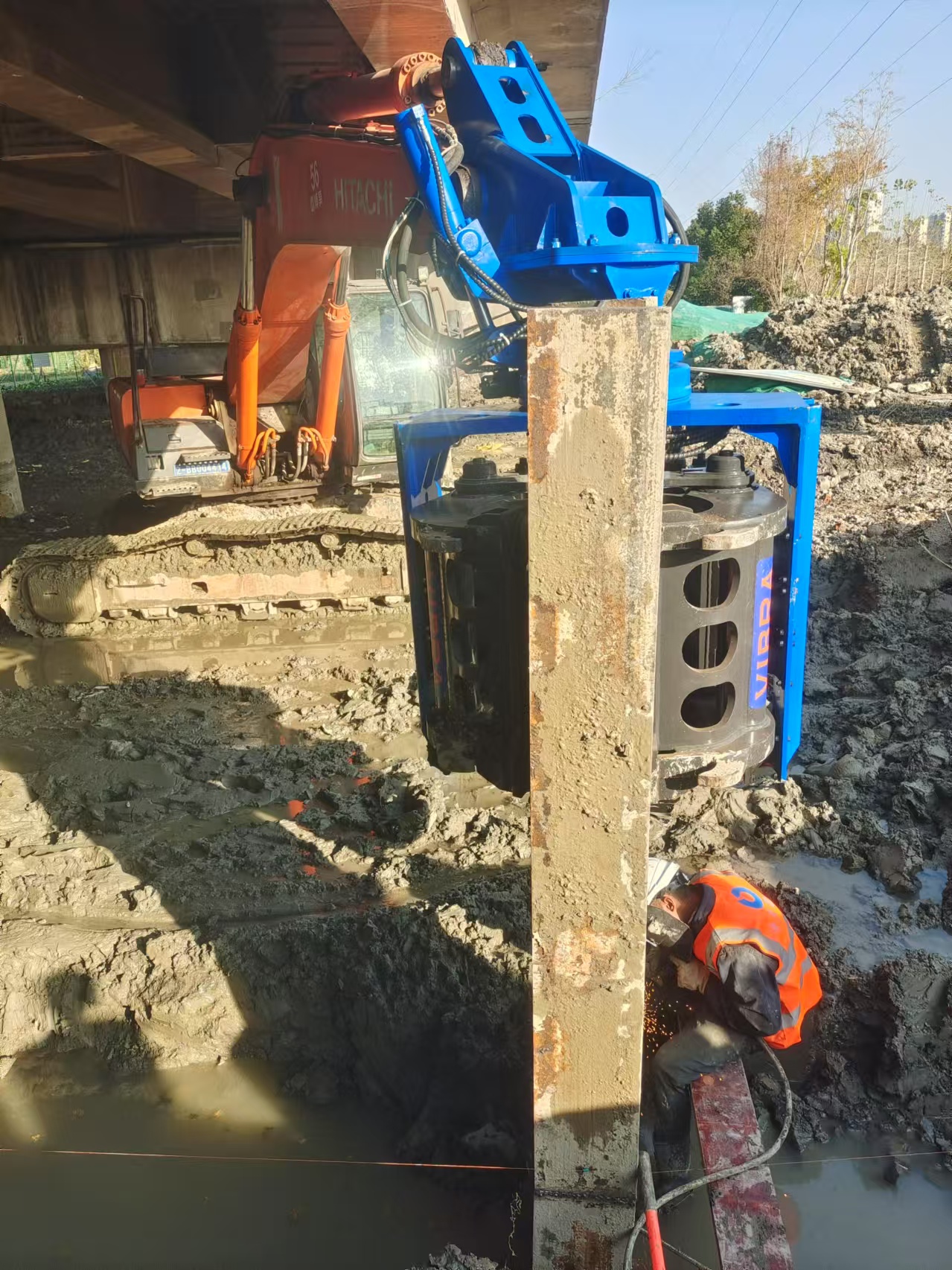
The relevant signal for mid-size buyers is not which model ran that project, but the configuration logic behind it: restricted access and noise-sensitive sites are where a side-grip unit with rotation and tilt capability earns its place in the fleet.
Frequently asked questions
What certification should buyers verify before importing an SV-200 or SV-400?
The SV-200 and SV-400 are both listed on the manufacturer's Certificate of Quality Management System Certification, certificate number 11724QU0068-05R0S, issued by ICAS under the standard GB/T 19001-2016 / ISO 9001:2015, covering the manufacture of construction machinery (hydraulic pile driving and extracting machines) and spare parts. The certificate was issued on 10 May 2024 and is valid until 9 May 2027. For projects in the United States, dedicated pile drivers fall under OSHA 1926.1439, which includes a provision that applies only to dedicated pile drivers manufactured after 8 November 2011. Buyers should confirm their own target-market import requirements in addition to the manufacturer's certificate.
Can the SV-200 or SV-400 be customized for a specific excavator, pile type or brand requirement?
Yes. The manufacturer states OEM and ODM production, with customization covering colour, brand logo, pile driver specifications and clamp types. The minimum order quantity is one set, and every unit is 100% tested. Because the SV-200 and SV-400 have different published excavator ranges — 20–25 t and 32–40 t — configuration questions, including clamp type for sheet pile, H-beam or other sections, are best settled before the order is placed.
What drives the cost of an SV-200 or SV-400, and how should a budget be built?
No verified list price for the SV-200 or SV-400 is published in the sources reviewed, so budget planning should be based on a configuration-specific quotation rather than a catalog figure. The variables that change scope are the model class itself (2,280 kg for the SV-200 against 3,870 kg for the SV-400), clamp and specification customization, branding requirements, and the shipping and import terms for the destination market. Because the minimum order quantity is one set, a single-unit quotation is a valid starting point for comparing suppliers on equal scope.
Can a buyer validate one unit before committing to a fleet order?
A single unit is a valid order: the stated minimum order quantity is one set, and units are 100% tested before delivery. Field validation is supported by remote technical support and a one-year warranty. For a first order, the practical validation path is to confirm the carrier's hydraulic supply against the model's operating pressure (32 MPa for both models) and flow range (170–230 L/min for the SV-200, 230–280 L/min for the SV-400), then run the unit against the pile section and ground conditions it was specified for.
What lead time and after-sales support should be planned?
Lead time is stated as 30–45 days, with single-model production capacity of 20 sets per month, so a mid-size order does not require an extended wait but does require planning around the production slot. After-sales support includes remote technical support and a one-year warranty. Buyers preparing a tender or import dossier should also note that the quality management certificate is valid until 9 May 2027. To move from evaluation to a firm specification, request a configuration-specific quotation and the current product catalogue from Shanghai Yekun Construction Machinery (VIBRA).
Which of the two belongs on your shortlist?
The split is clean when the carrier is the starting point. For a 20–25 t excavator, the SV-200's 459 kN centrifugal force, 2,280 kg body and 335/385 kN clamp forces define a unit sized for that class. For a 32–40 t machine, the SV-400's 656 kN, 3,870 kg body and 465/520 kN clamp forces are the matching set. Both share 360° rotation, ±30° tilt, a 32 MPa operating pressure and a high-strength steel body, so the decision rests on carrier class, hydraulic supply at 170–230 or 230–280 L/min, clamp force against the pile section, and documentation.
On documentation, the SV-200 and SV-400 are both named on a quality management system certificate issued under GB/T 19001-2016 / ISO 9001:2015 and valid until May 2027 — a detail worth locking into any evaluation matrix alongside the specifications.
Next step: sample unit, quotation and catalogue
Shanghai Yekun Construction Machinery Co., Ltd. (VIBRA) supplies the SV-200 and SV-400 with a minimum order quantity of one set, 100% testing before delivery, OEM/ODM customization, a stated lead time of 30–45 days and a one-year warranty with remote technical support.
Product catalogue (PDF): VIBRA hydraulic pile driver brochure
Website: hydraulic-piledriver.com
Email: leon_lee@vibracn.com
Tel / WhatsApp: +86 13918742829
Have Questions or Need More Details?
Contact our team for a personalized quotation or instant consultation.
Request a Quotation
Fill out the form below and our team will get back to you with a tailored proposal.
WhatsApp Direct Chat
Prefer to chat in real-time? Message us on WhatsApp for instant assistance & quick answers.
- Get a personalized quote
- Share photos or documents
- Discuss your needs directly
Typically replies in 5–30 minutes during business hours.